- Straight-Away Towing Service Raleigh NC
- (919) 234-5400
- support@straightawaytowing.com

Why Flatbed Towing for AWD Vehicles Is the Safer Choice

Construction Equipment Towing: What Raleigh Contractors Need to Know
July 5, 2026
How to Move a Disabled Car Safely Off the Road
September 5, 2026
Your AWD crossover just broke down on the side of I-40 in Raleigh, and a tow truck is on the way. You are relieved, stressed, and just ready to get somewhere safe. But here is something most drivers do not think about in that moment: the type of tow truck that shows up matters just as much as how fast it arrives.
This article explains why flatbed towing for AWD vehicles is the recommended method, what can go wrong when the wrong tow is used, and how to make sure you are asking the right questions when you call for help. Whether you drive a full-time AWD crossover or a part-time 4WD pickup, understanding this before a breakdown happens puts you in a much better position when it does. Straight Away Towing is available to Raleigh drivers at (919) 234-5400 and our team is ready to walk you through your options when you call.
What Makes AWD Vehicles Different From Regular Cars
An all-wheel drive system powers all four wheels at the same time through a network of connected mechanical components. This includes the transmission, a transfer case, a front differential, a rear differential, and a series of driveshafts that link everything together.
In a standard two-wheel drive vehicle, only one axle is driven. The other two wheels roll freely and independently, which is why a wheel-lift tow on a 2WD car is generally straightforward. With an AWD system, all four wheels are mechanically linked. That connection is what makes AWD effective on slippery roads and uneven terrain, but it is also what creates a specific vulnerability when the vehicle needs to be towed.
How the Wrong Tow Can Damage an AWD System
This is the part most drivers are never told, and it is worth understanding clearly.
When a wheel-lift tow truck lifts only one end of an AWD vehicle, the wheels still on the ground continue to rotate as the truck moves down the road. Because those wheels are connected to the rest of the drivetrain, their rotation forces the driveshafts, differentials, and transfer case to spin along with them. Under normal driving conditions, those components are lubricated by circulating transmission and differential fluid. During a wheel-lift tow, the engine is off, the fluid is not circulating, and those components are spinning without proper lubrication.
The result is heat, friction, and wear on parts that can cost thousands of dollars to repair. The damage does not always show up immediately. A driver might pick up their vehicle from the shop, drive it for several weeks, and then notice rough shifting, vibrating, or total drivetrain failure. By that point, connecting the problem back to the tow is difficult, and the repair bill is very real.
Specific components that carry the most risk during an improper tow include the transfer case, front and rear differentials, and the transmission output shaft. These are not inexpensive components to replace.
AWD vs. 4WD: Is There a Difference When It Comes to Towing?
The terms AWD and 4WD are often used interchangeably, but they describe different systems, and that distinction matters during a tow.
Full-time AWD systems, which are common in crossovers and many modern SUVs, have no neutral mode for the transfer case. The drivetrain is always engaged. These vehicles should always be towed on a flatbed, without exception.
Part-time 4WD systems, which are more common in body-on-frame trucks and traditional SUVs, sometimes include a transfer case with a neutral setting. When the transfer case is in neutral, the drivetrain is effectively disconnected, and a two-wheel tow may be safe for short distances. However, this varies significantly by make, model, and year. Some manufacturers explicitly prohibit wheel-lift towing even with the transfer case in neutral.
The safest approach for any driver who is unsure of their exact drivetrain configuration is to request a flatbed. It eliminates the guesswork entirely.
What Is Flatbed Towing and Why Does It Protect Your Vehicle?
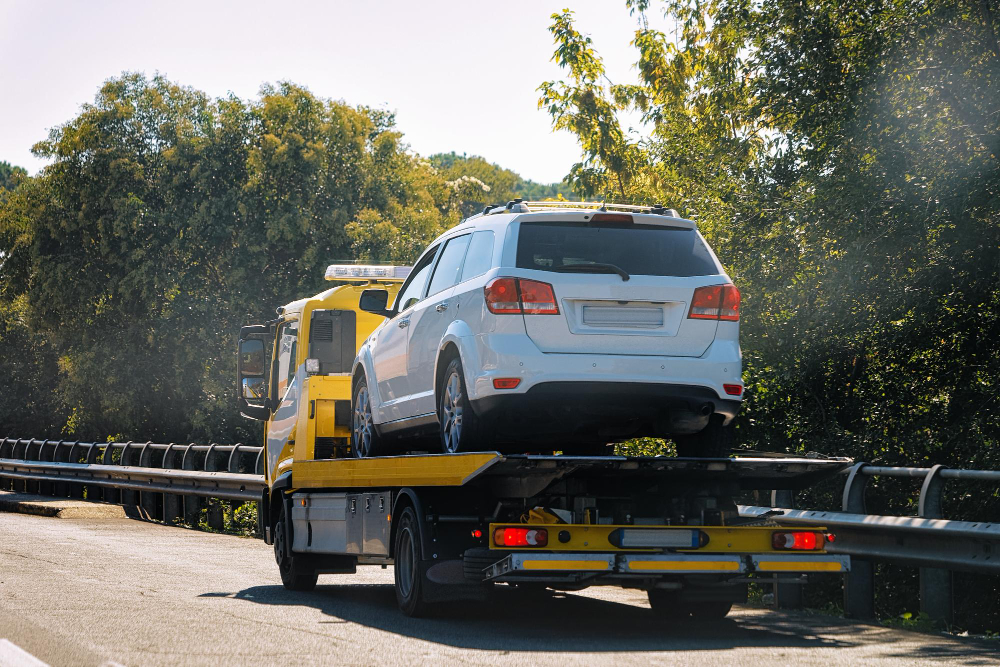
Flatbed towing means the entire vehicle is loaded onto a flat platform and all four wheels leave the ground completely. The vehicle is secured to the bed with straps or chains and transported without any wheels rolling during the process.
Because no wheels are turning, no drivetrain components are engaged. The transmission, transfer case, and differentials remain completely still from the moment the vehicle is loaded until it is driven off the flatbed at the destination. This is what makes flatbed towing for AWD vehicles the correct and recommended method according to most vehicle manufacturers.
It also protects the undercarriage, exhaust system, and any lowered or modified components that might be vulnerable during a traditional hook-and-chain tow.
When the Risk Is Highest
Not every breakdown puts an AWD system at immediate risk, but certain situations raise the stakes considerably. Knowing when to be especially firm about requesting a flatbed can prevent a costly mistake.
- When the vehicle is a full-time AWD model with no neutral transfer case option, a flatbed is the only appropriate choice regardless of tow distance.
- When the driver is unsure whether their vehicle has AWD or 4WD, or does not know whether a neutral transfer case setting exists, defaulting to flatbed is the right call.
- When the vehicle is already experiencing mechanical trouble beyond a flat tire, adding drivetrain stress through an improper tow can compound an existing problem.
- When a roadside assistance provider dispatches a truck without confirming your vehicle type first, it is worth asking specifically what equipment is being sent before it arrives.
Highway breakdowns are also a higher-risk scenario simply because of the speed involved. A wheel-lift tow at highway speeds puts significantly more strain on spinning drivetrain components than a short, slow move in a parking lot.
What to Ask When Calling for a Tow
Being informed in a breakdown situation is not about being difficult. It is about protecting a significant financial investment. When calling for towing assistance, three questions can make a real difference.
First, ask whether the company has a flatbed truck available and whether it can be dispatched for your location. Not every provider has flatbeds, and confirming this upfront saves time. Second, let the dispatcher know your vehicle is AWD or 4WD so they can assign the appropriate equipment from the start. Third, if you are working through a roadside assistance program or insurance provider, confirm that a flatbed has been specifically requested rather than just the nearest available truck.
A knowledgeable towing company will understand the question immediately and confirm the right equipment without hesitation. Straight Away Towing operates in Raleigh and the surrounding area and can be reached at (919) 234-5400 if you want to confirm equipment availability before dispatching.
The Bottom Line on Flatbed Towing for AWD Vehicles
AWD and 4WD vehicles have drivetrain systems that are vulnerable to serious damage when towed with wheels on the ground. The connected nature of all-wheel drive means that wheel rotation during a tow translates directly into unlubricated movement inside the transfer case, differentials, and transmission. Flatbed towing eliminates that risk entirely by keeping all four wheels off the road from pickup to drop-off.
Knowing this before a breakdown happens gives you the ability to ask the right question at the right moment, rather than finding out the hard way after the fact.
If you drive an AWD or 4WD vehicle in Raleigh, North Carolina, Straight Away Towing is available at (919) 234-5400. Reach out to us whenever you need to confirm the right towing method for your vehicle or want a flatbed dispatched to your location. We would rather answer one extra question upfront than see you deal with a preventable repair bill later.